Before naming your boat, ask yourself these 5 questions

It’s not easy to name a boat. Much thought goes into it, akin to naming a child. In this scene of The Simpsons, you can get an idea of the process, but I have yet to come across a similar source of inspiration for naming a boat and so, can only share my thought process with you.

Superstition and tradition aside, one should consider the following five questions:

  1. Where will you be sailing?

If you don’t plan on going abroad you can almost chose any word in your dictionary, country map or yellow pages, provided you consider the questions below. However, if your intention is to sail beyond your maritime boundaries, be considerate of differences in languages, accents and possibly offensive or ridiculous names. A fail that comes to mind is Mamada, which in Mexico refers to oral sex or an absurd statement. This vessel was recently anchored in Labuan Bajo, Indonesia, so not at risk of being bullied by Mexicans for the time being.

2. Is it easy to understand when pronounced on the radio?

VHF radio is still the primary means of communication at sea. It is used between vessels in proximity of each other, by the harbour master, navy, coast guard and other authorities, by marinas and even ship chandlers and shore-side restaurants. Anyone who has ever used a walkie-talkie (which, by the way, the French, who don’t like to corrupt their language with anglicisms, refer to as talkie-walkie) or simply seen a movie or show where police communicate with radios, knows that the clarity of speech is highly degraded.

For VHF to be audible, it is necessary for the antennas of the transmitter and receiver to be in sight of one another. As such, vessels place them atop of their masts and coast guard stations, on hills or buildings. Distance, quality, age and power (watts) of the radio will play an important role on clarity. Therefore, avoid choosing a name which is only audible in your own language or is comprised of numerous words. You will lose valuable time and possibly the receiver’s patience if you have to pronounce your vessel’s name several times before he or she finally gets it.

In the Sea of Cortez, I came across a yacht called Taw & Torridge. Aside from being a name more appropriate for a law firm, imagine a non-Brit trying to understand this over the VHF. The owner of this yacht is a really nice guy and I mean no disrespect by using this name as an example.

3. How long does it take to spell it out?

Though VHF is pretty easy to use, the frequencies available for communication are limited and it is important that users avoid having long conversations over the radio, in particular over channel 16, which is the international emergency and maritime safety frequency. Long and complicated names not only add unnecessarily to the duration of a broadcast, but also pose a safety risk when they involve a vessel in distress. A receiver can request that a word not understood be spelled out using the phonetic alphabet. If you are not familiar with this alphabet or do not have it glued to your chart desk, it may be a while before you find it or you might end up inventing alternatives and having to spell those out too. But having a complicated name also has the potential to put those trying to assist you in a predicament. Imagine a scenario where your boat is taking water 100 nautical miles offshore and your only means of reaching the coast guard is by having one, two or three vessels relay your message to them. In such an instance, your creative impulses are now imposing the burden of mastering the phonetic alphabet onto others.

One of the coolest, cleverest names I’ve come across is Tequila Mockingbird, but I would hesitate giving my boat this name for the following reasons: Aside from combining two words, it uses all the vowels and eleven consonants. Phonetically, this is what it translates to:

Tango, Echo, Quebec, Uniform, India, Lima, Alfa, Mike, Oscar, Charlie, Kilo, India, November, Golf, Bravo, India, Romeo, Delta.

And you still haven’t gotten to stating the nature of your emergency, described your vessel or whether you intend to abandon ship or not.

4. Is the name very common?

There are names that keep popping up, whether in the Pacific, Atlantic, Mediterranean or elsewhere: Freedom, Destiny, Serenity, Carpe Diem, Compass Rose, Second Wind, etc. If you’ve been to more than one marina, you know which ones they are. It seems that in an effort to abide by the previous recommendations, imagination has been annihilated. There are two immediate risks associated with this apathy. The first is that in a distress situation, if a call sign, MMSI number or registration number, flag and/or description of the vessel has not been duly noted, authorities who only have a name to go by may end up looking for a vessel that is quite distinct to yours.

The second risk is that vessels have a tendency to accumulate debts in the ports and marinas they visit, either with port officials, crew, fuel suppliers, yard workers, etc. These debts follow the boat and not necessarily the owner. In legalese, we call them liens, and anyone considering to have a valid claim may ask a judge to issue an order for the arrest of such a ship on entering the harbour. With a common name, it may be just a matter of time before you get mixed up in something completely unrelated to you. While you may deem yourself honorable and innocent, depending on where you are, it could take plenty of time and money (legal fees, bribes, etc.) before you are allowed to continue on your marry way.

5. Does the name mean anything to you?

Can you imagine Pink Floyd as Screaming Abdabs, Depeche Mode as Composition of Sound, Led Zeppelin as The New Yardbirds or Nirvana as Fecal Matter? Like rock bands, you will probably be asked more than a couple of times where the name of the boat comes from or what it means, so it would be wise to have an idea, even if not an eloquent answer. As in their case, you are certainly entitled to repent and change the name, but this may entail both paper and paint work, money, or simply be so cumbersome that you abandon the idea altogether.

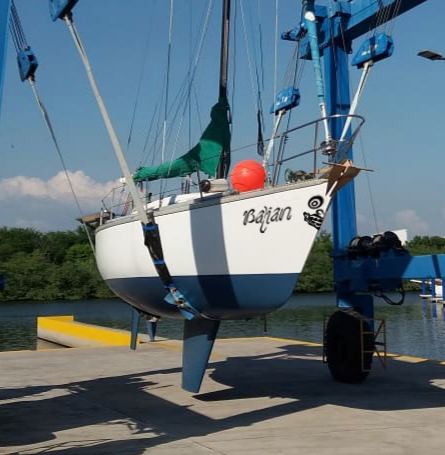
I decided to name my first boat Balian, after a quiet, friendly beach in Bali where I spent a month assimilating the death of my best friend, Alejandro Furlong, a.k.a. Sacha Mandinga, who died of a brain tumor just two weeks after catching his last wave in Lombok. In Balinese, Balian also refers to a healer or shaman.
20190727_2342445033248937110321768.png

Recent study shows Komodo Dragon prefers fried rice over live prey

According to UNESCO, the Komodo National Park is home to approximately 5,700 Komodo Dragons, so-named because of their intimidating looks and aggressive behavior. The Komodo is currently the largest lizard on the planet, weighing up to 70kg (150lb) and averaging a length of 2 to 3 metres (or up to 10 medium-sized feet).

A survey conducted by scientists interested in Darwin’s blasphemous theory of evolution showed that these fearsome lizards now prefer the local staple, Nasi Goreng, over the many deer, monkeys, rats and buffalo who share its habitat. Most of today’s dragons live in the vicinity of the numerous canteens the park rangers have set up on the islands of Rinca and Komodo. There they are fed, like millions of Indonesians, fried rice for breakfast, lunch and dinner. Komodos spend the hours between meals lying flat on their bellies, occasionally smiling when photographed by the many tourists that interrupt their digestive process every day.

DCIM102GOPRO

As in the case of Luis Suarez, Uruguay’s most famous vampire, the Komodo Dragon was for-long judged severely on account of the bacteria in its mouth, capable of mortally infecting its victim within days of an attack. Today, however, (like Suarez in Barcelona) it peacefully coexists with the park rangers and tourists, making a live Komodo as docile as a dead one. According to local rangers, it will at best get up from its place of slumber after months of starvation, which occurs prior to the arrival of a National Geographic team or Sir David Attenborough.

Still, one ranger added, with blue screens, green screens and digital animation, this rarely ever happens anymore, as one action-filled documentary footage is recycled over and over by different producers, often simply flipping the images to fool the viewers into believing they are seeing never-before-seen footage. Scientists have therefore concluded that while the lizards are unlikely to grow in length, like Mexicans, they will probably evolve into more obese beings.

Lastly, the survey also showed that when given the option between Mie Goreng -fried noodles- and Nasi Goreng, the dragons were more inclined to go for the rice dish, and that a fried egg on top went a long way into getting them to look happier in selfies.

Many thanks to AJ Rush for allowing me to use her very good pictures for this post.

I Married a Prickly Pear

I married a prickly pear
Was smitten on the phone
Seemed a great idea
Now I am all stung.

To tend to all your needs
I share a room with nine
Roaches of the night
Skip lunch and seldom dine.

When you’re ready we shall sail
Through doldrums, storms and trash
To islands threatened by the sea
Do I need to bear the rash?

For to give a voice to those
Who’ve been salted and would flee
Must I first endure this pain?
Must I first make out with thee?

Under the scorching sun of Mexico
Or in the heat of your saloon
Muse in disrepair
You make itch even the Moon.

You are meant to be a healer
Yet you fill me with your spine
Fiberglass from Hades
Are you really a Balian?

Down the corporate ladder and up the yard ladder

Three years ago I was on the beautiful island of Rote, Indonesia, with my mate Furlong, a.k.a. Sasha Mandinga, discussing with some Aussie surfers the feasibility of flying to Australia to learn how to sail and get jobs as deckhands. We had been enjoying touring across Indonesia on our motorbikes but realized that such an archipelago could only really be conquered by boat (if at all possible, considering its 17,000 or so islands).

IMG_0544.JPG

Not long thereafter, Furlong died and I was left to decide whether I should go back to the office life I had known for almost ten years and found unfulfilling or actually try to learn to sail and pursue the idea of cruising. Clarity (and courage) came during a Vipassana meditation retreat in Bali and, determined, I quickly found an opportunity to enslave myself at a sailing school in Phuket, Thailand. During my first year there I worked in exchange for experience and qualifications, became a yachting instructor and participated in a couple of regattas.

Picture from MBS / Cape Panwa Hotel Phuket Raceweek 2017

Tight rounding of the leward mark. Our team is flying the yellow spinnaker. Photo taken from SEA Yachting Magazine

Life in Phuket was awesome and the sailing, great, so I decided to stick around for another year, this time paid just enough to cover my rent, some beers and Thai lessons. Within that second year I was invited to help Captain Norm take his 49ft Bruce Roberts across the Indian Ocean, an experience that only confirmed I had been right in staying away from the suits and ties, for, as Yann Martel’s Piscine Molitor so rightly puts it, «I [had] nothing to say of my working life, except that a tie is a noose, and inverted though it is, it will hang a man nonetheless if he’s not careful.»

As I was reaching the end of my second year in Thailand I felt I was living the life of a retired expat, lacking in mental and physical challenges, spending too much time and money at the Ship Inn, the local pub, and decided to look for another crewing opportunity, hoping for a paid one. This time, Captain Craig distracted my search with a crazy proposal: to sail east from Sand Point, Alaska, along the Aleutian chain, in freezing temperatures and against the prevailing winds, to Russia’s westernmost frontier, Kamchatka, and then south following the Kurils, to Hokkaido, Japan.

I had already seen his plan on a crewing website and didn’t even consider it. There was a Hallberg Rassy making its way to Phuket which would then head to Sri Lanka, the Maldives, Chagos and around the Cape of Good Hope. It was not a paid gig, but the fact that I had all the appropriate clothing (shorts and flipflops) and that a 15-minute ride to the marina would lead me half way around the world had an enormous appeal. For the Bering Sea, on the other hand, I would be subject to constant shit weather, have to spend heaps on gear and flights and go through the hassle of applying for a Russian visa. Had it not been for Craig’s email, I’d be snorkeling in some tropical paradise right now.

But Craig planted a seed. He mentioned he was looking for someone who spoke Russian and was keen on climbing volcanoes, which was enough for me to give his plan a closer look. It took about a month for me to make up my mind. In the meantime, I quit my job, the Hallberg Rassy arrived in Phuket, I had some beers with her very friendly Danish skipper and was very tempted to leave for Sri Lanka. But the seed was sprouting. I believe what decided it was the advice of my friends Ana and Jose, regulars at the above-mentioned pub. They put it very simply: there will always be another opportunity to sail to Sri Lanka and so on, but maybe never another to explore the Aleutian Islands.

So I called the crazy Kiwi, told him I was in and asked him what gear I needed. Aside from the obvious, he suggested I get some snow shoes (which he had to explain are not the same as snow boots), a gas mask, an immersion suit, avalanche kit and a sleeping bag appropriate for freezing temperatures; suggestions which only confirmed how insane the plan was. I then spent over a month shopping, packing, processing my visa, studying the weather and currents and making my way to Sand Point. At the same, as if I could juggle more crazyness, my friend Daniel, one of the owners of the beautiful Casa Blat Ha in Holbox, called me to say he knew of a good, cheap yacht for sale that I should buy. And so I did.

The journey from Alaska to Hokkaido proved indeed to be a once-in-a-lifetime experience, rich with adrenaline, challenges, surprises and lessons. In this blog I’ve shared some of these adrenaline-laden and challenging moments; I’ve written about the beautiful people we met every step of the way and have posted some crappy pictures of the amazing scenery and wildlife we were fortunate to encounter. Below are some taken by the more talented photographer, Craig, whose blog you can visit here.

DSC_0230

DSC_0229

DSC_0190

dsc_03311399432043.jpg

dsc_0279635571124.jpg

dsc_02971037936784.jpg

img_2136334130475.jpg

dsc_0402410870058.jpg

dsc_0407505710893.jpg

DSC_0333dsc_0758859373628.jpgdsc_0623522970454.jpg

Concerning the lessons learned, Craig was a great Captain in that he delegated many maintenance tasks and repairs to me; lessons which now give me the confidence, if not necessarily the skills, to take on the challenge of restoring the S/V «Rossa», a 33ft Bayliner Buccaneer, to its former glory. Following three great weeks in Japan, I went back to Phuket, packed whatever stuff I had left and flew home to Mexico, where, after months of thinking about this 1979 fiberglass yacht, I finally found her in a boatyard in Puerto Chiapas, close to the border with Guatemala.

20180829_160315543917501.jpg

I’ve been here for almost two weeks, at first just staring at her, not knowing where to begin, then gradually tackling what I could manage, like organizing the tools left on board and buying what I felt was missing, then examining and mending her sails, and now I’ve moved on to what I am clueless about: plumbing and preparing the hull for a new paint job. Rossa’s previous owners were awesome in handling most of the woodwork the inside needs and still advise me when I get stuck. Youtube and Google haven’t been the great aids I had hope for, so I’m mostly learning from my mistakes, specially when fooling around with epoxy. Don’t expect the coming posts to teach how to restore your own boat.

Here’s a bit of what I’ve done so far:

The People of the Ring of Fire

In my last post I mentioned my concern at having reached the climax of the trip while sailing along the Aleutian Islands, and how this concern proved unfounded when we reached Kamchatka.

I then left Russia quite sad, feeling I had barely scrapped the surface of this remote frontier and convinced I would do all in my power to return as soon as possible.

I was not overly excited about arriving to Japan and thought I’d soon thereafter confirm the end of my trip and board a plane to Phuket or Mexico. And again, I was proven wrong.

Otaru, on the island of Hokkaido, is one of the most amazing places I have ever been to. It’s inhabitants are extremely friendly and welcoming, the town very beautiful, the weather perfect (sometimes even too hot for us accustomed to the cold of the Okhotsk and Bering seas), Otaru Beer, simply delicious, and their tradition of Taiko drumming, breathtaking. We were fortunate to arrive right before a three-day festival which commemorates the anniversary of the town and offers a tribute to the sea. Three days of eating street food, dancing, drinking, exchanging smiles with gorgeous girls clad in kimonos, karaoke, Taiko and parades.

I am not a volcano enthusiast to the degree of my Captain, Craig, and while I can readily admit that volcanoes create the most stunning scenery on this planet, following this incredible journey which started in Sand Point, where the people treated us like family, all through Alaska and on to Kamchatka and Hokkaido, it is the love and fire-filled people of this part of the Ring, including my crewmates, who will forever remain engraved in my heart and who make me want to come back as soon as my newly acquired sail boat is fit to cross the Pacific.

But I am also ready to admit, after so many pleasant surprises, that this world is full of smiles and that my plans may derail as I attempt to make it back. And that is my most valuable lesson and the Truth that will for long, if not forever, keep me from returning to a monotonous desk job routine. A wise man born in the same town as I once said that to live is to travel (H.C. Andersen). I guess he was right.

Kamchatka

While sailing along the Aleutian Islands, marvelled by their volcanic beauty, the presence of walruses, orcas, sea lions, albatros, grey and humpback whales, I started wondering how I would ever top such an experience.

And then we crossed over to Kamchatka. After six days on the open ocean, late in the evening, with a sun still shining bright on the Home Volcanoes which surround Petropavlovsk-Kamchatski and ushered by a pod of five or six dolphins, we entered, though unconsciously, into Russia’s territorial waters. All through the evening and the entire moonlit and becalmed night we could hear the breathing and burping of whales around us, though they were shy to show themselves.

The following morning, we were welcomed into Avacha Bay by some of the friendliest customs and immigration officers I’ve come accross, one of which rivalled in beauty with another who the previous year had welcomed me to Madagascar.

After all the formalities we were guided to a yacht club where again the welcome was formidable, with fish, crab, beers and vodka pouring from our neighbours on the slip.

Despite the many hangovers, we managed to meet a lot of wonderful people, do some gorgeous trekks, climb and ski down an active volcano and fall in love with this remote part of Russia.

And so two amazing weeks have passed and it is again time to say goodbye and sail on to another surprise: the Kuril Islands and Hokkaido. I will try to come back to what our last days in Alaska were like, including the details on the accidental gybe that severely fractured the boom, our losing an anchor while anchored at the base of Mount Cleveland in the Islands of the Four Mountains, taking shelter from the hurricane that struck Hawaii and sent high waves and strong wind towards us, killer whales confusing us with seals and other tales of fun and scary sailing in northern latitudes. In the meantime, here are some pictures of the last few weeks.

Worth pointing out is the S/V Infinity, then moored in Dutch Harbour and now bound for the North Pole and across the North West Passage, beautiful Mount Cleveland, old Cold War infrastructure on Adak, WWII relics and craters on Kiska, caviar and Tolbachik Volcano.